
As my previous post made clear, my recourse when things are busy & hectic is to often resort to crime fiction – it’s less demanding, provides escapism, and (often) ties things up in a neat resolution (unlike real life!). However, in amongst the serial killers, police inspectors and spycraft, I’ve managed to read a few non-fiction books. So here are some brief reviews of 5 of those, in order of how highly I’d recommend them:
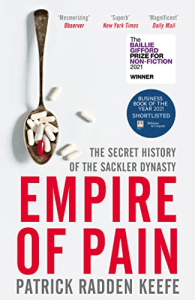
1) Empire of Pain: The Secrety History of the Sackler Dynasty by Patrick Radden Keefe – I remember reading Dopesick by Beth Macy four years ago and it hugely opening my eyes to the opioid epidemic in the US, which it does brilliantly and affectingly through individual examples of spiralling decline. Radden Keefe’s book takes an in-depth and sweeping look at the family whose pharmaceutical business prompted and kick-started that epidemic, the Sacklers. It is a fascinating and disturbing tale; what was particularly excellent about it is the way in which the long family history (of the original three Sackler brothers) shows how all the elements and techniques that came to pass later on (with OxyContin) were in evidence in their earlier pharmaceutical work: lobbying, using ‘evidence’ for marketing, influencing regulators, placing profits over the health of customers, using philanthropy for credibility and so on. So although the story itself is less new than it was to me in 2018/2019, there are plenty of new insights and shocking moments, and a depth to the narrative that unfurls that meant this lingered with me long after the Sackler name starts to be taken off the walls of the world’s museums and art galleries.
2) Bad Blood: Secrets and Lies in A Silicon Valley Start-Up by John Carreyrou – another health business gone wrong, and this one tells the amazing story of Elizabeth Holmes and Theranos, the blood testing business she set up which promised to revolutionise health testing and medical analysis. She is a deeply curious individual, who changes the way she speaks, positions herself as a female Steve Jobs, persuades a coterie of influential elderly men onto her board, and deceives a wide range of business leaders and investors over a substantial period of time. It’s a well-known tale at this point (if you look it up, you can see where Holmes is now…) but Carreyrou was one of the first journalists to start digging and to break the story in all its extraordinariness – and he lays it all out expertly. As ever, while it is a fascinating insight into a strange individual, it is the impact on others which hits hardest – the collateral damage is significant amongst employees, family, friends, businesses and patients alike.
3) Midnight In Chernobyl by Adam Higginbotham – if you haven’t seen the mini-series Chernobyl, I highly recommend it and I think this book was used as the basis for it. However, the book is worth reading too for the sheer amounts of detail it provides – which is equal parts horrifying and unbelievable. Higginbotham places the building of Chernobyl in both the context of preceding nuclear accidents (including Three Mile Island in the US) and also of the different factions of the Soviet political system. It’s extensive and exhaustive – and pretty terrifying; I can remember hearing about acid rain as a schoolboy in 1986, and of stories of sheep with three eyes, but I’m deeply glad I had no idea about how close we all were to a much more significant disaster. There are, as you would expect, amazing tales of individual bravery, a scary lack of knowledge of what to do, and a great deal of covering up (in every sense). Higginbotham tracks people down for interviews many years hence, and these give up some of the book’s most powerful moments. If you have the slightest interest in the topic, I highly recommend this.
4) The Cult of We: WeWork and the Great Start-Up Delusion by Eliot Brown and Maureen Farrell – another crazy and well-known recent Silicon Valley blow-up. This one involving the cult-leaderish Adam Neumann who managed to convince countless investors (and one major one) that WeWork wasn’t, in fact, a trendier version of other co-working spaces / rented offices, but actually a technology company like Uber or Apple or Amazon – which allowed him to get more investment and a higher valuation…and more investment and a higher valuation; all the time running at a massive loss. It is the arrogance and self-indulgence of Neumann (and his wife) that is astonishing – he buys a private jet for no reason; they create their own school for their children (because nothing else will do), then treat the staff appallingly; they buy nine homes; they trademarked ‘We’ and leased it back to the company…all while pretending their employees are part of the ‘We’ family, some sort of egalitarian utopian dream. He also wanted to be the first trillionaire, expand WeWork to Mars, and become ‘world president’ – not necessarily in that order. And, unlike Holmes, he walked away largely unscathed (indeed, with a reported net worth of $2.2bn), even receiving a pay-off on the way out – having crashed his own company. What’s equally shocking is the enablement of his behaviour by others – by the board, investors, financial advisors and many more; and that enablement continues to some extent today, as he is still operating as an entrepreneur. Hubris writ large – and written excellently by the authors.
5) No Filter: The Inside Story of Instagram by Sarah Frier – my disclaimer on this one is that I’m not really an Instagram user, but am intrigued by Silicon Valley successes as well as collapses. In the case of Instagram, I think it’s interesting to see how it emerged, how it grew and what happened when it was taken over by Facebook – there are some business lessons here which don’t just relate to the insulated and insular world of Silicon Valley entrepreneurship and investment; and some interesting points about business culture and how and why it matters. The latter sections of the book go into more detail on the nature of influencing and how this has itself become a business model ‘created’ by Instagram; I couldn’t give two hoots about the Kardashians, but if you wonder how people are making a living through photos on their phone, this is worth a read too. The only reason I place this behind the others is that I felt it wasn’t as judicious in its use of outside context – so the inside story was told excellently, but what this meant for the world not quite so much; perhaps that’s because the story isn’t over yet.
A final non-fiction note that I’m currently reading Pete Apps‘ excoriating, forensic and heartbreaking Show Me The Bodies, about Grenfell. I haven’t finished it yet, but I’m entirely unsurprised it has recently won the Orwell Prize for Political Writing: it’s required reading.
 Dog-eared Man: a book a week